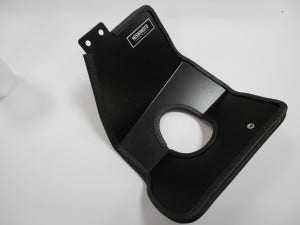

With positive horsepower data and an impressive intake tone, all our goals were met, so it was time to move towards project completion. We set out to finalize the design, finishes, and construction of our production units and, as you can see below, they turned out quite well. This will be offered in three finishes including polished aluminum, wrinkle-red, and wrinkle-black. Each kit includes an intake pipe with air straightener and MAF housing, a Mishimoto high-flow air filter, a heat shield, a silicone coupler, clamps, and all hardware necessary for installation.
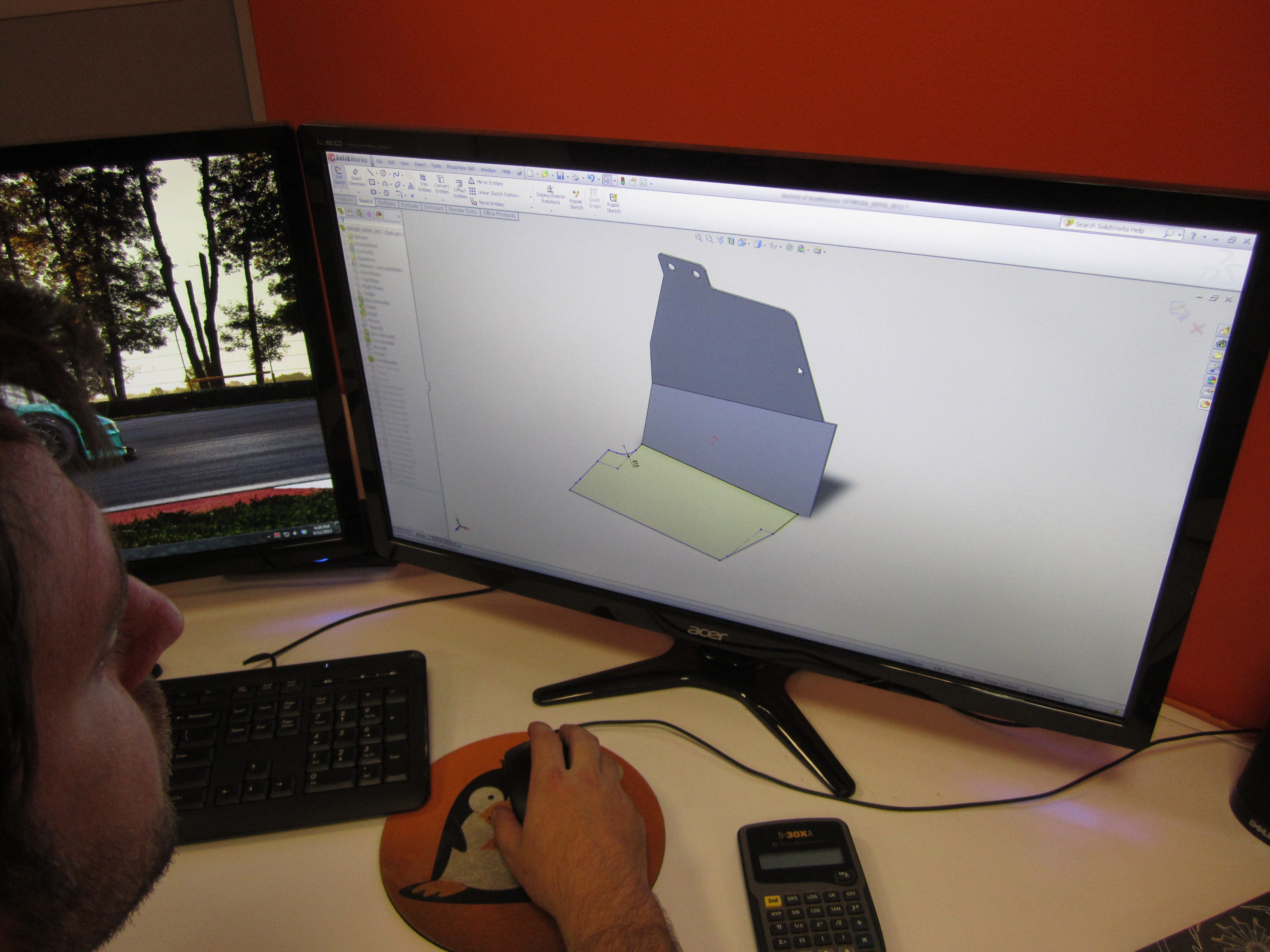
Completed air filter shroud design
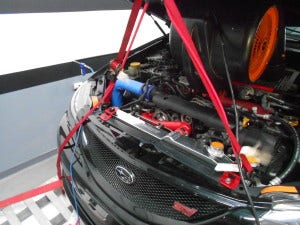
Mishimoto intake fully installed
Fully installed kit
Completed Mishimoto intake pipes with wrinkle finish
Mishimoto intake pipes and air filter
Mishimoto one piece air straightener
This kit provides a true bolt-on, high-performance air intake that produces
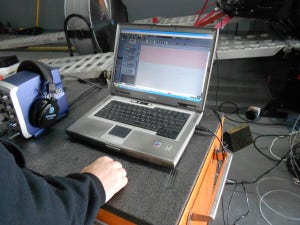
Finally, we come to the sound improvements that the Mishimoto intake provides. Everyone loves a nice throaty intake sound, almost as much as the intoxicating burble from a set of unequal-length headers. During our many dyno pulls, collection of data for decibel strength was something we wanted to explore and compare between the factory design and our design.
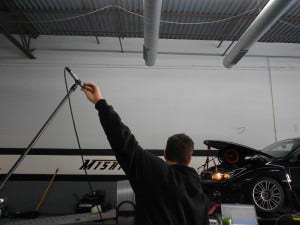
Intake sound testing
Microphone for intake sound testing
From the lead engineer on this project:
“The recorded sounds were analyzed to compare the relative decibel strengths across the entire bandwidth of frequencies. The red and blue lines in the graph below (Figure 3) represent the maximum volume achieved for each frequency band during the entire dyno pull.
A note about frequencies: The range of human hearing is typically about 20
It was now time to see the fruits of our labor and collect some data with our revised design. Our poor STI was once again strapped to the dyno (This is what it’s built for, right?) and endured pull after pull as we evaluated power, AFRs, sound improvements, and durability. Weeks of testing resulted in a design that not only pleased our engineers, but also excited them to see some enthusiasts install and use it. Bolting on 25 whp has never been easier, and this intake shows gains through the entire power band.
Dyno testing final design
More dyno testing
Everyone loves dyno videos!
And … the results are in! As shown below in Figure 1, our air intake makes substantially more power over the factory intake throughout the entire power band, especially in boost. Also shown are the AFRs of both the OEM and Mishimoto intakes. Although leaner than the
With our initial designs complete and fully assembled, the engineers were ready for testing. We strapped our STI to the dyno and began making some initial pulls with the car completely stock and using the OEM intake. We were averaging upper 250s to lower 260s at the wheels, which was what we expected from this car. After having some fun we removed the factory intake system, including the airbox, air induction tube, and MAF housing. We bolted on our first design and made a few pulls. We found that the air/fuel ratio (AFR) was a bit on the lean side for our tastes, so after a few runs we decided to call it quits for the day and reevaluate this design. Bolting on the second design provided slightly improved AFRs, but they were still at a point where we were a bit uncomfortable. This was our main concern, as the vehicle seemed to be putting out pretty
Here we are at round two of product development. The shear, brake, and welder had quite a workout as our team set to work on developing two very different prototypes for testing.
The first design was rather unique and emulated the factory system quite well. This large, box design used a standard panel filter and pulled cold air from the fender/wheel-well area. This unit was very well designed and would keep your engine bay appearing OEM while providing improved power and tone. The design used a large box of undecided material for construction (aluminum vs. plastic) and a short length of piping to house the mass airflow sensor (MAF). While this unit was under construction, a new design was also explored. This one used aluminum intake piping off the inlet tube running into the fender liner where a cone filter would be used. For improved heat resistance,
When you envision a performance automotive company, it is sometimes difficult to picture the effort going on behind the scenes. The project lifecycle from conception to completion is a hectic yet interesting process that encompasses discovery, data collection, improvement, and creation. High-quality polished images showcase the end result of hard work, but what really goes on while engineers fabricate components, test prototypes, and analyze data? All this effort is essential to create an efficient and accurate product that bolts into your vehicle and enhances performance, whether you are making a pass at the strip or clipping an apex at a hill-climb.
Enthusiasts are typically very curious about the technical aspects of their performance parts, so this should pique the interest of gearheads and petrol heads everywhere. The goal of this blog is